 Biscuit Wallet
Guide · · 9 min read
Arbitrum or Ethereum: which network for ETH, USDT and USDC?
Same coins, same address, very different fees. What changes, what doesn’t, and when each one is the right choice
Short answer: Arbitrum is a network built on top of Ethereum. It holds the same ETH, USDT and USDC, at the same address, but a send costs a fraction of a cent instead of a few cents or more, and it confirms in a second instead of about twelve. For everyday payments and small amounts, Arbitrum is the better choice. For large sums kept for years, or when the person you pay only accepts Ethereum, stay on Ethereum. Whatever you choose, the sender and the receiver must use the same network.
The rest of this guide explains why that works, what you trade for the lower fees, and the mistakes that cost people money.
What is Arbitrum?
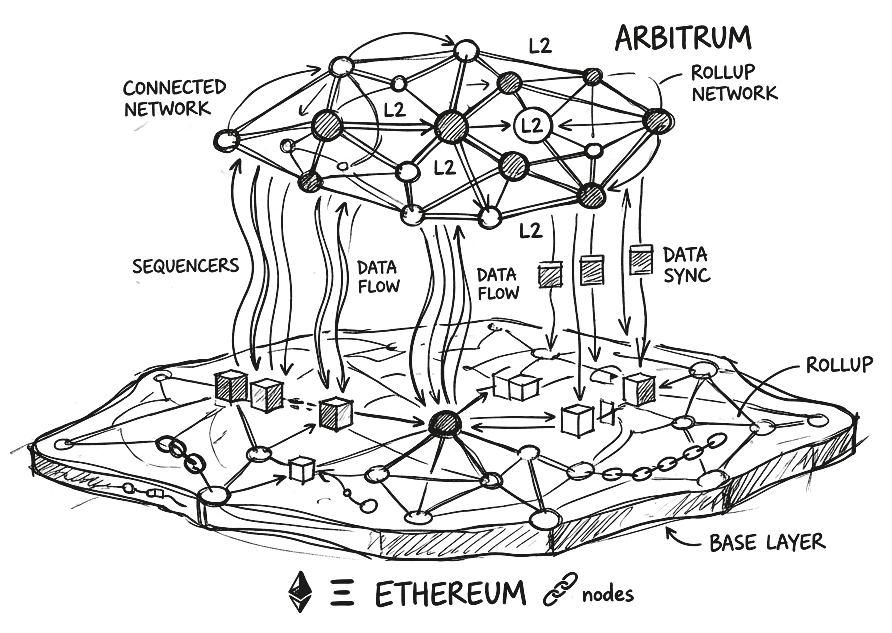
Arbitrum One is what is called a layer 2, or a rollup: a separate blockchain that runs its own transactions, then writes them, packed together, into Ethereum. Thousands of Arbitrum transfers share the cost of one entry on Ethereum, which is why each of them costs so little.
It went live in 2021, built by a company called Offchain Labs, and is now governed by the Arbitrum DAO, the holders of its ARB token. You never need ARB to use it: fees on Arbitrum are paid in ETH, like on Ethereum.
The important part is how Arbitrum stays honest. Its results are posted to Ethereum, and anyone can challenge a wrong one during a dispute window of about a week. Since February 2025, with an upgrade called BoLD, anyone can take part in those challenges, not only a list of approved validators. That is what lets Arbitrum lean on Ethereum’s security instead of asking you to trust its operators.
There is also a sister network, Arbitrum Nova, made for games and social apps, with weaker guarantees. When people and exchanges say “Arbitrum” for payments, they mean Arbitrum One, and so does this guide.
Arbitrum vs Ethereum at a glance
| Ethereum | Arbitrum One | |
|---|---|---|
| Cost of a USDT send | A few cents on a calm day, much more when the network is busy | A fraction of a cent |
| Fee paid in | ETH on Ethereum | ETH on Arbitrum |
| Time to confirm | About 12 seconds per block | About a second |
| Your address | The same 0x… address on both, with separate balances | |
| USDT | Tether’s USDT (ERC-20) | USDT0, Tether’s USDT on Arbitrum |
| USDC | Circle’s USDC | Circle’s native USDC (not the older USDC.e) |
| Security | Ethereum itself | Settles on Ethereum, with an operator and upgrade keys of its own |
| Back to Ethereum | — | About a week through the official bridge; minutes through an exchange |
| Privacy | None: every transfer is public, on both | |
How much does a transfer cost on each?
On both networks, a transfer pays for the work it asks of the network, called gas, at a price that rises when the network is busy. Sending USDT or USDC needs more gas than sending ETH, because it goes through the token’s contract.
On Ethereum, on most days in 2026, a USDT send costs a few cents. When many people want their transactions in the next block, the gas price can be ten times higher for a few hours, and so is the fee. Our guide Why do I need ETH to send USDT? works through the numbers.
On Arbitrum, the same send usually costs well under a cent. A dollar of ETH on Arbitrum covers hundreds of sends. The fee rises a little when Ethereum is busy, because Arbitrum still pays Ethereum to store its data, but it stays tiny.
In both cases the fee comes from ETH on the same network. ETH on Ethereum can’t pay for a send on Arbitrum, and the other way round. A wallet with USDT on Arbitrum and no ETH on Arbitrum can’t send it, even with plenty of ETH on Ethereum.
Is Arbitrum as safe as Ethereum?
Nearly, but not quite, and it’s worth knowing where the difference lies.
- Your coins can’t be taken by Arbitrum’s operators. Transfers are signed by your keys, as on Ethereum, and wrong results can be challenged on Ethereum by anyone.
- One company orders the transactions. A single sequencer, run by Offchain Labs, puts transactions in order. It can’t forge or steal, but it could delay you or go down for a while. If it ignores a transaction, the sender can push it through Ethereum directly after about a day.
- The system can be upgraded. Arbitrum’s contracts on Ethereum can be changed by a vote of the DAO, after a delay that leaves time to leave, or quickly by an elected Security Council in an emergency. That is a power Ethereum’s own coins don’t depend on.
Independent reviewers such as L2BEAT, which grades rollups on exactly these points, place Arbitrum One among the most mature. For everyday amounts, these risks are small. For savings you would hate to see frozen even for a day, Ethereum itself remains the simpler bet.
What is USDT0, and is it the same as USDT?
It is Tether’s USDT on Arbitrum. In January 2025, Tether upgraded the USDT contract on Arbitrum in place into USDT0, a version that moves between networks through LayerZero, a cross-chain messaging system, instead of Arbitrum’s own bridge. Holders had nothing to do: their USDT simply became USDT0, still worth one dollar and still backed by Tether. Explorers and exchanges show it as USDT0 or USD₮0; most exchanges simply call it USDT on Arbitrum One.
USDC has a similar story. Since June 2023, Circle issues USDC directly on Arbitrum. The USDC that came across Arbitrum’s bridge before that is called USDC.e (bridged USDC) and is a different token. Most exchanges now send native USDC; if one offers USDC.e, it is a separate choice.
Biscuit holds Tether’s USDT0 and Circle’s native USDC on Arbitrum, the same versions exchanges send.
One address, two networks
This is the part that confuses everyone. Your Ethereum address, the one starting with 0x, works on Ethereum and on Arbitrum. It comes from the same keys, so it is the same text on both. But the two networks don’t share balances: USDT received on Arbitrum is only on Arbitrum.
Think of one name on two bank accounts at two different banks. Same name, two balances, and money sent to one doesn’t appear at the other.
Because the address is the same, the address alone never says which network a payment uses. The sender chooses it when they send. That is why an exchange asks you to pick a network when you withdraw, and why you have to tell anyone who pays you which one to use.
What happens if USDT is sent on the wrong network?
It depends on where it goes:
- To your own wallet, on Arbitrum instead of Ethereum, or the other way round: nothing is lost. The coins are at your address on the other network. Show that network in your wallet, and they are there.
- To your own wallet, on another network that uses 0x addresses (BNB Chain, Polygon, Base…): the coins are at an address your seed controls, but a wallet that doesn’t support that network won’t show them. Restoring the same words in a wallet that supports it gets them back.
- To an exchange or a shop, on a network it doesn’t support: the coins reach an address the exchange controls, but its systems never see them. Some exchanges recover them for a fee, after days or weeks; many don’t. Treat them as lost.
- From Tron: Tron addresses start with T, not 0x, so a transfer from Tron can’t reach a 0x address at all. Tron is a separate world.
The rule that avoids all of this: before every payment, both sides say the network out loud. “USDT on Arbitrum One” or “USDT on Ethereum (ERC-20)”, never just “USDT”.
How to move coins from Ethereum to Arbitrum
You don’t send from one network to the other like a normal payment: a send stays on the network it starts on. Three ways work:
- Withdraw from an exchange directly to Arbitrum. The cheapest and simplest. Most large exchanges let you withdraw ETH, USDT and USDC on Arbitrum One: choose it as the network, paste your usual 0x address.
- The official Arbitrum bridge (bridge.arbitrum.io). From Ethereum to Arbitrum takes about ten to fifteen minutes and costs one Ethereum fee. The way back, from Arbitrum to Ethereum, takes about a week: that is the dispute window described above. Fast bridges skip the wait for a fee.
- A swap. An exchange takes your coins on one network and pays out on the other. In Biscuit, the same coin on Ethereum and on Arbitrum count as two different coins on the Swap tab, so you can swap from one to the other, or straight from ETH on Ethereum to USDT on Arbitrum, when an exchange offers the pair.
Whichever you choose, keep a little ETH on Arbitrum for fees. When you withdraw USDT from an exchange to Arbitrum, withdraw a dollar or two of ETH on Arbitrum with it.
When should you use Ethereum, and when Arbitrum?
Use Arbitrum for payments, small and medium amounts, anything you move often, and when you receive from an exchange that supports it. It is where USDT makes sense as digital cash.
Stay on Ethereum for large amounts held for years, when the person or service you pay only accepts Ethereum, and when you would rather not depend on anything but Ethereum itself.
Many people keep both: a reserve on Ethereum, and spending money on Arbitrum.
Is Arbitrum more private than Ethereum?
No. Every transfer on both networks is public, with its amount, its sender and its receiver, and anyone can read it on a block explorer. And since your address is the same on both, anyone who knows it sees your activity on both at once. If you need payments that aren’t public, that is what Monero is for; our guide on getting Monero without KYC covers how to get some.
Ethereum and Arbitrum in Biscuit
Biscuit holds ETH, USDT and USDC on both networks, each on its own tab: ETH, USDT and USDC for Ethereum, and the same three marked (Arbitrum). You add only the ones you want, with the + on Send and Receive; adding a token adds the ETH of its network too, since its fees are paid in it.
- Every receive page says which network it is for, so you know what to tell the sender.
- The Send tab shows the fee in your currency before you send, and warns you in red when there isn’t enough ETH on that network to pay it.
- All of it comes from the same 12 words as your other coins, on the address most Ethereum wallets use, so it restores elsewhere.
- In Tor mode, Biscuit reaches the Ethereum and Arbitrum nodes through Tor, so they don’t see your IP address next to your balance.
See Ethereum, USDT and USDC in Biscuit for the details.
Quick answers
Is ETH on Arbitrum a different coin from ETH?
It is the same ETH, moved onto Arbitrum: one ETH on Arbitrum can always be brought back as one ETH on Ethereum through the bridge. But wallets and exchanges handle them separately, because they live on different networks.
Do I need the ARB token to use Arbitrum?
No. ARB is used to vote on how Arbitrum is run. Fees are paid in ETH.
Can I send from Arbitrum to an Ethereum address?
Any 0x address is valid on both networks, so the send goes through, but it arrives on Arbitrum. If the receiver only watches Ethereum, they won’t see it. Check which network they expect first.
Why does withdrawing from Arbitrum to Ethereum take a week?
The official bridge waits for the dispute window to pass, so that a wrong result could still be challenged. Exchanges and fast bridges pay you on Ethereum right away from their own funds, for a fee.
Is USDT on Arbitrum backed like USDT on Ethereum?
Yes. Every USDT0 is backed by a USDT locked on Ethereum, one for one; USDT0 only changes how USDT travels between networks.
Are fees on Arbitrum always lower?
For ordinary sends, yes, by a wide margin. They rise a little when Ethereum is very busy, but stay far below Ethereum’s own.
Learn more
- Why do I need ETH to send USDT?
- Ethereum, USDT and USDC in Biscuit
- Ethereum fees and speeding up
- Exchange swaps
- Arbitrum’s documentation and Arbitrum on L2BEAT
Questions? Write to us through the contact page.