 Biscuit Wallet
Guide · · 7 min read
Why do I need ETH to send USDT?
Network fees on Ethereum, explained without the jargon
Short answer: USDT on Ethereum is not a coin of its own. It is a balance kept by a program on the Ethereum network, and every change to that balance is an Ethereum transaction. Ethereum only accepts its fees in ETH. So to move your USDT, the same address needs a little ETH for the fee. Receiving costs nothing; sending always does. The same goes for USDC.

If you have just landed here because a wallet refused to send your USDT, nothing is broken and nothing is lost. Your dollars are still there. You only need a few dollars’ worth of ETH on the same address. The rest of this guide explains why, how much, and the one trap to avoid while fixing it.
Why is the fee paid in ETH, not in USDT?
Think of sending a cheque by post. The cheque can be for any amount, in any currency, but the stamp on the envelope is bought at the post office, in the post office’s money. A cheque for a thousand dollars doesn’t pay for its own stamp.
On Ethereum, USDT is the cheque and ETH is the stamp.
Under the hood, Tether runs a small program on Ethereum, called a contract, that keeps a list of addresses and how many USDT each one holds. When you “send 25 USDT”, your wallet actually sends an Ethereum transaction to that contract saying: move 25 from my line of the list to this other line. The people who run Ethereum’s network check that transaction, put it in a block and keep it there forever. They get paid for that work, and they are paid in ETH, whatever the transaction carries.
Tether can’t pay your fee for you, and neither can the USDT you are sending: the fee is settled before the contract even looks at your balance.
What is gas on Ethereum?
Ethereum measures the work a transaction asks for in units called gas. The fee is simply:
fee = gas used × gas price
- Gas used depends on what you do. Sending ETH from one address to another always uses exactly 21,000 gas. Sending USDT or USDC runs the token’s contract, so it uses more: usually between about 40,000 and 65,000 gas, two to three times as much. Sending to an address that has never held the token costs the most.
- Gas price depends on how busy the network is, and is counted in gwei, a billionth of an ETH. When many people want their transactions in the next block, the price goes up; when the network is quiet, it goes down.
Part of the fee is burned, part goes to whoever adds your transaction to a block. Either way, it leaves your address in ETH.
How much does it cost to send USDT?
Less than people expect, most of the time. On most days in 2026, the gas price on Ethereum stays under 1 gwei. A USDT send at 0.5 gwei with 65,000 gas costs:
65,000 × 0.5 gwei = 32,500 gwei = 0.0000325 ETH
That is a few cents, or a little more depending on the price of ETH. When the network gets busy, gas can be ten times higher for a few hours, and so is the fee. If your payment isn’t urgent, waiting is often the cheapest option.
So you don’t need much ETH. A few dollars’ worth covers many sends.
Can I swap my USDT for ETH if I have no ETH?
Here is the situation people get stuck in. You withdraw USDT from an exchange, or a friend pays you in USDT, and your address holds no ETH at all. The obvious idea is to swap a few USDT for ETH.
That doesn’t work. A swap starts by sending your USDT to the exchange, and sending USDT is exactly the thing you can’t do without ETH. Every way out of the address goes through the same door.
The ETH has to come in from outside:
- From another wallet where you already have some ETH, including another wallet of yours.
- From an exchange: withdraw a little ETH along with your USDT. If you are about to withdraw USDT to a new wallet, send a few dollars of ETH there first.
- With a swap from another coin: if you hold another crypto, swap a small amount of it for ETH, with your Ethereum address as the destination. In Biscuit, that is an exchange swap. Swaps have a minimum amount, shown with each offer.
Send the ETH to the same address that holds your USDT. On Ethereum, one address holds ETH, USDT and USDC together, and the fee must come from the address that sends.
Can I send USDT without ETH?
Not directly. Some apps and services offer “gasless” USDT sends. They don’t remove the fee: a third party pays it in ETH for you and takes its money back in USDT, usually with a margin. That works, but it puts one more company between you and your payment, one that sees it and can refuse it. Biscuit doesn’t do this. Holding a little ETH is cheaper and keeps you in control.
Is it the same for USDT on Tron or Solana?
Yes. USDT and USDC exist on many blockchains, and each one charges its fees in its own coin: TRX on Tron, SOL on Solana, BNB on BNB Chain. The cheque changes post office, the stamp changes currency.
This also means the network matters. USDT on Tron and USDT on Ethereum are not the same thing, even though they share a name, and an address on one network can’t receive tokens from another. Biscuit holds USDT and USDC on Ethereum only (ERC-20). If someone pays you, always tell them to use the Ethereum network.
How does Biscuit handle USDT fees?
We wanted this to be impossible to get wrong, without hiding anything from you.
- When you add USDT or USDC, Biscuit adds Ethereum too, and tells you why: the fees are paid in ETH.
- Before you send, the Send tab shows the fee in your currency and in ETH: about what it will cost, and the most it can cost if fees rise before your transaction is in a block. You only pay what is used, usually the first figure.
- How busy Ethereum is shows right under it, as a gas price in gwei: grey when the network is calm, orange when it is busy, red when it is very busy, with a reminder that waiting is often cheaper.
- If the address doesn’t have enough ETH, a red line says so before you try: “This wallet has 0 ETH: not enough for the network fee. Receive a little ETH on this address first.” Biscuit won’t send a transaction that would fail.
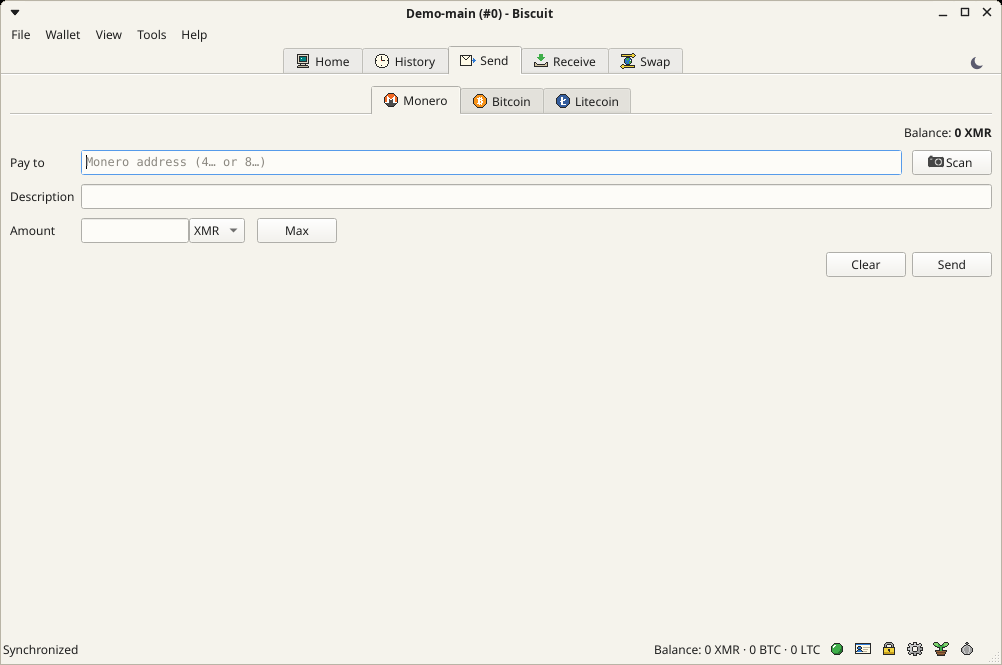
What Biscuit doesn’t do is buy ETH for you behind your back. How you get your ETH, and from whom, is your choice; Biscuit just makes sure you know you need it.
And if a payment is waiting too long because fees rose suddenly, right-click it in History and choose Speed up (raise the fee). Biscuit sends the same payment again with a higher fee; only one of the two can ever go through.
How to get ready for your first USDT send
- In Biscuit, open Receive and choose Ethereum. Copy your address (
0x…). It is the same address for ETH, USDT and USDC. - Send a few dollars of ETH to it, from another wallet, an exchange, or a swap.
- Wait until it shows in your balance.
- Open Send, choose USDT or USDC, paste the address you are paying and enter the amount.
- Check the fee line: no red line means the ETH is enough. Click Send, check the details and confirm.
If you don’t have Biscuit yet, you can download it for Windows, macOS and Linux. It is free and open source.
Quick answers
Does receiving USDT cost me anything?
No. The sender pays the fee. You can receive USDT on an address with zero ETH; you just can’t send it on until you add some.
Can I pay the fee in USDT?
Not on Ethereum itself. Only through a third party that pays the ETH for you, as explained above.
Why does sending USDT cost more than sending ETH?
Because it runs the token’s contract, which is more work for the network than a plain ETH transfer.
Why did the fee change between two sends?
The gas price follows demand on the network, block after block. A few minutes can make a difference; a busy afternoon can make a big one.
I sent USDT and it says Pending. Is it lost?
No. The fee was probably too low for a sudden rise. It will go through when fees come down, or you can speed it up from History.
Learn more
- Ethereum fees and speeding up: the reference page
- Ethereum, USDT and USDC in Biscuit: one address, one seed, Ethereum network only
- Exchange swaps: getting ETH from another crypto
- How to swap Bitcoin for Monero without an exchange
Questions? Write to us through the contact page.