 Biscuit Wallet
Guide · · 6 min read
How to get Monero without KYC
Every way that still works, and what each one costs you
Short answer: the easiest way to get Monero without identity checks is to swap another crypto you already hold for XMR through an exchange that doesn’t ask for ID. If you hold Bitcoin and can wait an hour, an atomic swap does it with no exchange at all. You can also trade with another person, get paid in Monero, or mine it. Whichever you choose, send the Monero straight to your own wallet.

Holding Monero is legal in most countries. What changed is where you can get it: Binance and OKX removed it in early 2024, Kraken stopped offering it to European customers at the end of 2024, and from 10 July 2027 regulated platforms in the EU may no longer offer privacy coins at all. That rule applies to exchanges, not to you or your wallet. Here is what still works.
What does “no KYC” mean?
KYC, “know your customer”, is the identity check regulated exchanges must run: a photo of your ID, a selfie, sometimes proof of address. That file is kept for years, linked to every coin you buy and every address you withdraw to.
Getting Monero without KYC means nobody along the way asks who you are. It doesn’t mean nobody sees anything: depending on the method, an exchange may see your IP address, the amounts and the addresses involved. The methods below differ mostly in who you have to trust and what they can see.
1. Swap a coin you already have
If you already hold some crypto, an instant exchange can swap it for Monero in a few minutes, with no account. You send your coins to a deposit address; the exchange sends Monero to the address you gave.
An aggregator such as Trocador asks many of these exchanges at once and rates each one from A to D on how likely it is to ask for identity. Exchanges rated A are those that, in Trocador’s assessment, don’t ask for it.
Biscuit has this built in. On the Swap tab, choose what you send and that you want XMR, and Biscuit lists offers from A-rated exchanges only, ranked by what you actually receive. The Monero arrives on a new subaddress of your own wallet. Biscuit adds no fee. See Exchange swaps.
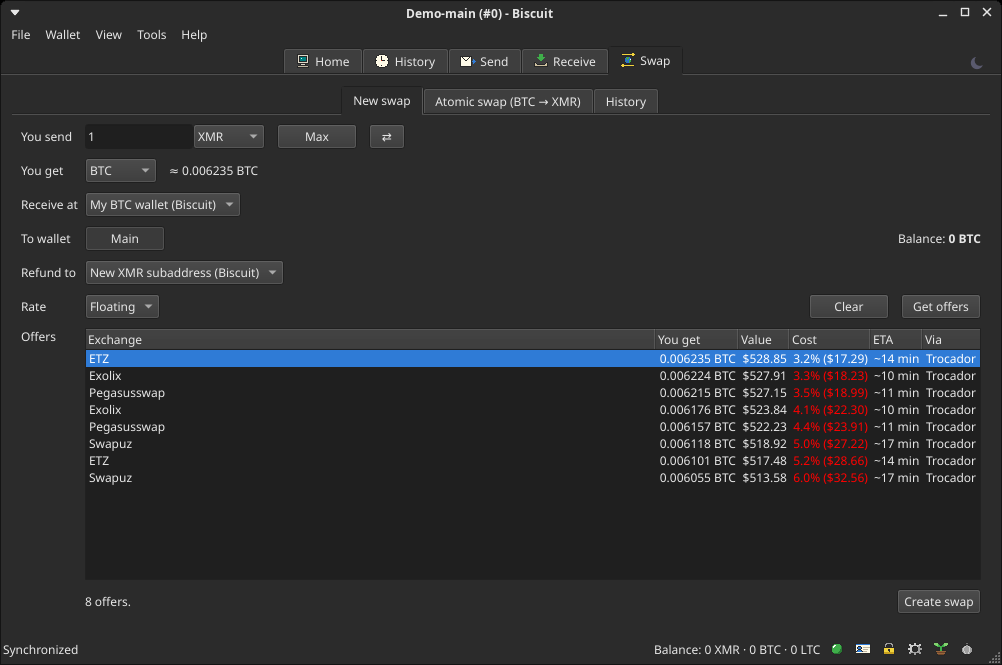
What it costs you: for a few minutes the exchange holds your coins, so you trust it to send the Monero. The exchange, the aggregator and, in Biscuit, our server see the swap and your IP address. An exchange can also stop a swap its anti-money-laundering checks flag and ask questions before it refunds. Keep amounts reasonable, and keep the trade ID until the swap is done.
2. Atomic swap from Bitcoin
An atomic swap trades your Bitcoin for a market maker’s Monero with nobody in the middle. The protocol, created by the eigenwallet project, is built so that either both sides get paid or your Bitcoin comes back to you. No one holds your coins, and it works over Tor.
Biscuit does atomic swaps on its Swap tab, and so does eigenwallet’s own app. We explained how it works, step by step, in How to swap Bitcoin for Monero without an exchange.
What it costs you: time. A swap takes about an hour, only goes from Bitcoin to Monero, and the wallet must stay open until it’s done. Makers set their own prices, and in Biscuit atomic swaps are still in beta.
3. Trade with another person
Peer-to-peer marketplaces put buyers and sellers in touch and hold both sides’ coins in escrow until the trade completes. For Monero, the main ones are networks running Haveno, a decentralized exchange built for XMR, and Bisq, where Monero trades against Bitcoin.
What it costs you: patience and some risk. Trades take longer, prices are often above the market, and payment by bank transfer tells your counterparty your name. Be aware that RetoSwap, the largest Haveno network, was hit by two exploits in May and June 2026 and paused trading; check a marketplace’s current status before you deposit anything.
Trading face to face for cash is the most private of all, and the oldest. It is also the one where your own judgment is the only protection.
4. Get paid in Monero
If you sell goods or services, you can ask to be paid in XMR. Freelancers, shops and donations pages already do. Directories such as Monerica list businesses that accept Monero, which also tells you where you can spend it.
What it costs you: nothing but asking. Give each payer a different subaddress: two people who paid you can’t tell they paid the same wallet.
5. Mine it
Monero is one of the few coins you can still mine on an ordinary computer. Its mining algorithm, RandomX, is designed for regular processors rather than special hardware. With P2Pool, you mine in a decentralized pool with no account and no sign-up, and rewards go straight to your address.
What it costs you: electricity. On a typical computer you will earn small amounts, often less than the power costs. It is a way to get Monero that has never touched anyone else’s hands, not a way to get rich.
Which method should I use?
| Method | Who holds your coins | Speed | Main risk |
|---|---|---|---|
| Exchange swap | The exchange, for minutes | Minutes | A flagged swap is held or questioned |
| Atomic swap | Nobody | About an hour | Bitcoin only; the wallet must stay open |
| Peer-to-peer | Escrow | Hours to days | Platform bugs, or the counterparty |
| Get paid | Nobody | Depends | None beyond the trade itself |
| Mining | Nobody | Slow | Costs more power than it earns |
For most people who already hold some crypto, an exchange swap is the quickest. If you have Bitcoin and an hour, an atomic swap leaves nobody holding your coins. If you can, getting paid in Monero is the cleanest of all.
Where should the Monero go?
Straight to your own wallet, not to an account on a platform: the whole point is lost if your coins end up on an exchange that asks for ID later.
- Use a new subaddress for each swap or payer. Biscuit does this for you on swaps.
- Back up your seed before you receive anything, and keep it offline.
- Hide your IP address if it matters to you: Biscuit can connect through Tor. Exchange swaps are off in Tor mode, because our swap partner requires us to record the IP address each swap is created from; atomic swaps work over Tor.
Biscuit is a free, open-source desktop wallet for Windows, macOS and Linux, with both kinds of swaps built in. You can download it here.
Quick answers
Is it legal to buy Monero without KYC?
In most countries, owning Monero and trading it with another person is legal; the identity rules apply to businesses, not to you. Laws differ by country, so check yours.
Why did exchanges delist Monero?
Because regulators ask exchanges to trace where coins come from and go to, and Monero hides that by design. Several large exchanges chose to drop it rather than argue.
Can I buy Monero with a card or a bank transfer without KYC?
Rarely. Card and bank payments carry your name, and services that accept them almost always check identity. The usual route is to get another crypto first, then swap it for Monero.
Is a no-KYC swap anonymous?
No. Nobody asks who you are, but the exchange sees the coins, the addresses and, unless you hide it, your IP address. Once the Monero is in your wallet, what you do with it is private by default.
What is the minimum amount?
Each exchange and maker sets its own. Biscuit shows the minimum and maximum with every offer before you choose.
Learn more
- Exchange swaps: the full reference
- Atomic swaps: the full reference
- How to swap Bitcoin for Monero without an exchange
- Why do I need ETH to send USDT?: before you swap USDT
- Tor in Biscuit
Questions? Write to us through the contact page.